

Piazza Navona is one of those places in Rome that does more than impress at first glance. It holds your attention because every part of it feels deliberate. The shape of the square, the movement of the fountains, the church façade, the obelisk, the open space itself. Nothing is random. Piazza Navona is not just a beautiful square. It is one of the clearest expressions of Roman Baroque art, built on top of ancient Rome and transformed into a public stage for sculpture, architecture, and urban identity.
Why Piazza Navona feels different from other squares in Rome
What makes Piazza Navona special is the way art and space work together. The square keeps the elongated shape of the ancient Stadium of Domitian, whose remains still lie below street level. That ancient footprint gives the piazza its unusual form and makes it feel wider, more theatrical, and more open than many other Roman piazzas. What visitors see today is a Baroque reinterpretation of an ancient site, where Rome’s layers are visible at once.
This is why Piazza Navona does not feel like a square you simply pass through. It feels composed. It invites you to stop, look around, and take in the relationship between architecture, sculpture, water, and movement. In Rome, that combination is an art form in itself.
A square shaped by Baroque vision
In the seventeenth century, Piazza Navona became one of the strongest showcases of Baroque Rome. This was the period when art was not treated as decoration, but as a way to create emotion, drama, and spectacle in public space. Piazza Navona became one of the great examples of that vision, with major works linked to Gian Lorenzo Bernini and Francesco Borromini, two of the defining figures of the Roman Baroque.
The square is not important only because it is beautiful. It is important because it shows how Rome used art to shape experience. Here, sculpture does not sit apart from the city. It becomes part of the city. Architecture does not act only as a backdrop. It enters into dialogue with the monuments in the square. Piazza Navona is one of the best places in Rome to understand how Baroque art was designed to be lived, not just admired.
The Fountain of the Four Rivers and the art of spectacle
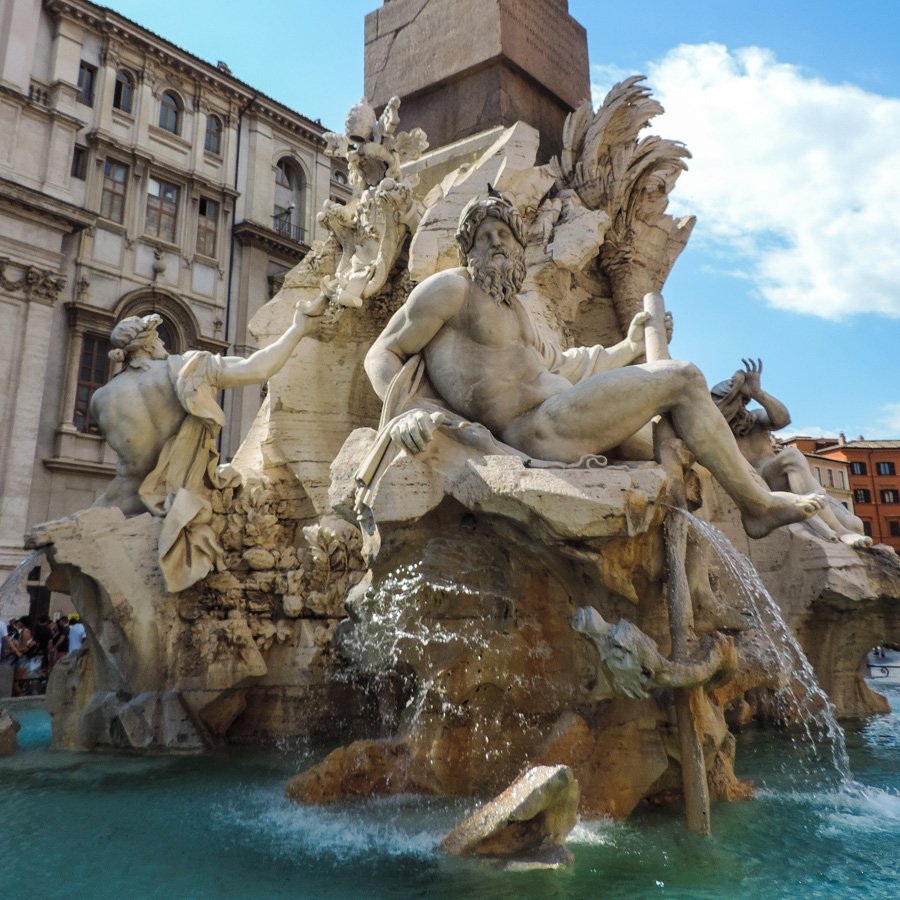
At the center of Piazza Navona stands its most famous masterpiece, Bernini’s Fountain of the Four Rivers. Commissioned for the Pamphilj family setting that included the piazza, palace, and nearby church, the fountain became one of Bernini’s greatest works and one of the most recognizable monuments in Rome.
The fountain represents four great rivers from four parts of the world known at the time: the Nile, the Danube, the Ganges, and the Río de la Plata. Above them rises the obelisk, creating the dramatic vertical effect that makes the monument feel unstable and powerful at the same time. Bernini turned stone into movement. The figures twist, lean, react, and seem almost caught in a living moment. That is one of the keys to Baroque art. It makes marble feel alive.
This is one reason Piazza Navona remains so memorable. The art in the square is not quiet. It performs. The fountain does not simply decorate the center. It commands it.
The dialogue between Bernini and Borromini
One of the most fascinating parts of Piazza Navona is the conversation between Bernini’s fountain and the church of Sant’Agnese in Agone, associated above all with Borromini’s intervention in the project. The church and the fountain face each other across the square, and together they create one of the most famous artistic tensions in Rome.
There is a well-known story that one of Bernini’s figures raises its arm in fear of the church façade collapsing, while another turns away to avoid looking at it. It is a great Roman legend, but it is not historically accurate, because the fountain was unveiled before Borromini’s façade was completed. Even so, the myth survived because it captures something true about Piazza Navona. The square feels like a meeting point between two powerful artistic personalities and two different interpretations of Baroque form.
That tension gives the piazza energy. Bernini brings sculptural drama and movement. Borromini brings architectural rhythm and complexity. Together, they turn Piazza Navona into more than a beautiful square. They turn it into a living lesson in Roman art.
More than one fountain, more than one masterpiece
While the Fountain of the Four Rivers dominates the center, Piazza Navona is shaped by three fountains in total. The Fontana del Moro and the Fountain of Neptune complete the square and help create its visual balance from one end to the other. Their presence matters because Piazza Navona was designed as a whole. The square is not built around one isolated monument. It is an ensemble.
This is part of the artistic intelligence of the piazza. Your eye does not stop in one place. It travels. The space opens, closes, and redirects your attention. That is why Piazza Navona works so well both up close and from a distance. It rewards detail, but it also works as a complete composition.
The art of Piazza Navona is also in its atmosphere
Art in Rome is never only inside museums. Piazza Navona proves that. Its artistic power comes not just from what was built there, but from how people experience it. The square is open, public, and alive. You see great sculpture and architecture not in silence behind glass, but in the middle of daily life.
That is part of its beauty. Piazza Navona shows how art in Rome belongs to the city itself. You do not need to plan a formal visit to feel its impact. You simply arrive, look around, and the square does the rest.
Why Piazza Navona still matters
Piazza Navona remains one of the most important artistic spaces in Rome because it brings together the city’s identity in one place. Ancient Rome is there in the shape of the stadium below. Baroque Rome is there in the fountains and the church. Public life is there in the open square that continues to attract visitors and locals every day.
That is what makes the art of Piazza Navona so powerful. It is not frozen in the past. It still works exactly as it was meant to. It still captures attention. It still creates emotion. It still turns urban space into experience.
Final thoughts
If you want to understand Rome through art, Piazza Navona is one of the best places to begin. It shows how this city turns history into form, and form into feeling. It shows how sculpture, architecture, and public space can come together in a way that still feels immediate centuries later.
Piazza Navona is not only something to see. It is something to read, to feel, and to return to. That is the real art of it.